Thailand Immigration Law governs how foreign nationals may enter, stay in and leave the Kingdom of Thailand.
The principal legislation is the Immigration Act B.E. 2522 (1979), together with ministerial regulations, notifications and subsequent amendments.
For foreign employees, investors, business owners and their families, understanding Thailand Immigration Law is particularly important because immigration status is closely connected with visa eligibility, permission to stay and, in many cases, the ability to work legally in Thailand.
Overview of Thailand’s Immigration Act B.E. 2522
The Immigration Act, Thailand Immigration Law regulates several important areas, including:
- entry into and departure from Thailand;
- temporary Stay Rules in Thai Immigration Law
- permanent residence;
- removal or repatriation of foreign nationals;
- immigration reporting requirements; and
- offences and penalties.
The Act defines an alien as a natural person who does not possess Thai nationality. It also defines an immigrant as an alien who enters the Kingdom of Thailand.
Entry into Thailand Under Immigration Law
Foreign nationals entering Thailand must generally use an authorised immigration checkpoint, port, station or designated area and comply with the applicable immigration procedures.
Section 11 of the Immigration Act requires persons entering or leaving Thailand to do so through prescribed immigration channels and at designated times.
Immigration officers also examine whether a foreign national falls within any prohibited category under Section 12.
For example, the Act addresses circumstances involving:
- lack of a valid passport or travel document;
- absence of a required visa;
- insufficient means of support;
- entry for work prohibited to foreigners; and
- certain health or other statutory grounds.
These requirements appear under Section 12 of the Immigration Act.
Main Visa Categories Under Thailand Immigration Law
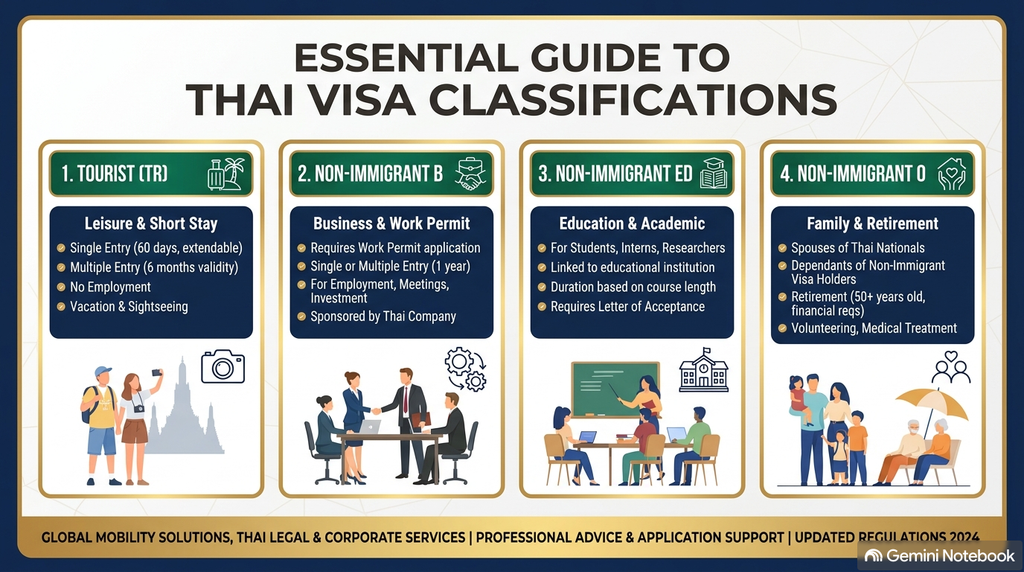
The Immigration Bureau training materials identify several common categories of entry into Thailand.+
Tourist Visa – TR
A Tourist Visa is intended for persons entering Thailand for tourism purposes.
Non-Immigrant B – Business Visa
A Non-Immigrant B Visa, commonly called a Non-B Visa, is generally associated with business activities and employment-related immigration status.
For many foreign employees, the Non-B Visa is one of the key immigration categories used together with the applicable work permit requirements.
Non-Immigrant ED – Education
The Non-ED category generally applies to study, education or certain training-related purposes.
Non-Immigrant O
Non-O may apply to several specified circumstances, including certain family, dependent, retirement and other qualifying situations.
Other Non-Immigrant Categories
The Immigration Bureau materials also identify categories relating to official duties, investment, religious activities, scientific research, skilled or expert work and other approved purposes.
Importantly, the appropriate visa category depends on the actual purpose of entry and the applicable immigration rules.
Temporary Stay Under Thailand Immigration Law (Section 34)
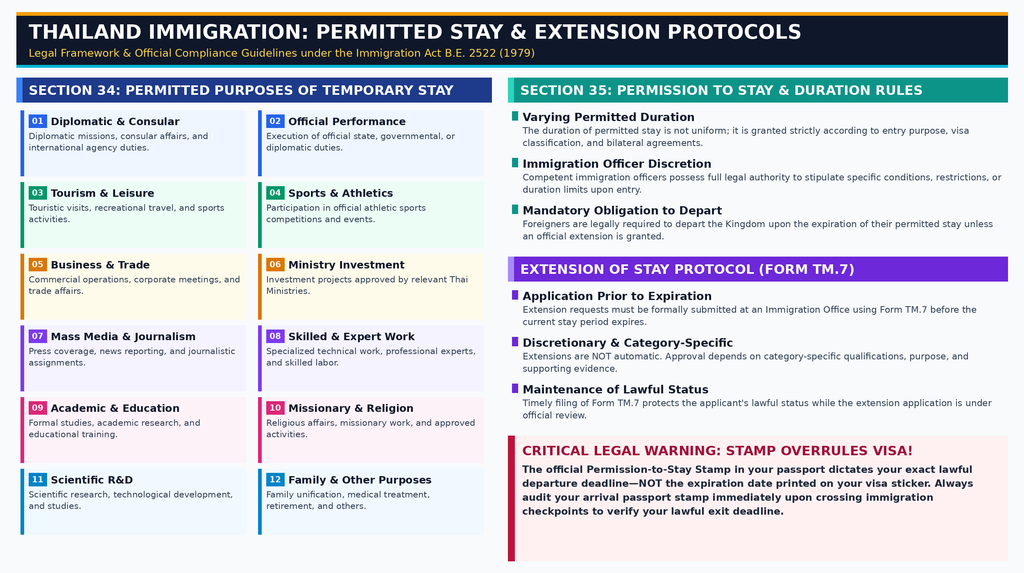
Section 34 of the Immigration Act specifies the purposes for which a foreign national may enter Thailand temporarily.
These include, among others:
- diplomatic or consular duties;
- official duties;
- tourism;
- sports;
- business;
- investment;
- transit;
- education;
- mass media activities;
- religious activities;
- scientific research; and
- skilled or expert work.
The statute expressly lists these permitted temporary-entry purposes.
This is important because a foreigner’s immigration status should correspond with the actual purpose of stay.+
How Long Can a Foreigner Stay in Thailand Under Immigration Law?
A visa and a permission to stay are related but not identical concepts.
Section 35 authorises the competent immigration authority to permit a foreign national entering temporarily under Section 34 to remain in Thailand subject to applicable conditions.
The maximum periods vary depending on the statutory purpose of entry. The Act includes different periods for tourism, business, investment and other categories.
Therefore, foreigners should always check the immigration stamp or official permission to stay rather than relying only on the visa sticker or visa validity date.
Extension of Stay Under Thailand Immigration Law
A foreign national who wishes to remain beyond the current permission period may need to apply for an extension of stay.
The Immigration Bureau training material refers to applications for temporary extension of stay and identifies Form TM.7 as the relevant application form.
However, approval is not automatic.
Eligibility, supporting documents and the permitted extension period depend on the applicant’s immigration category and the applicable Immigration Bureau rules.
For foreign employees, employers may need to prepare company documents, employment evidence and other supporting information as part of the immigration process.
Can a Foreigner Work While Staying in Thailand? Immigration Law vs Work Permit
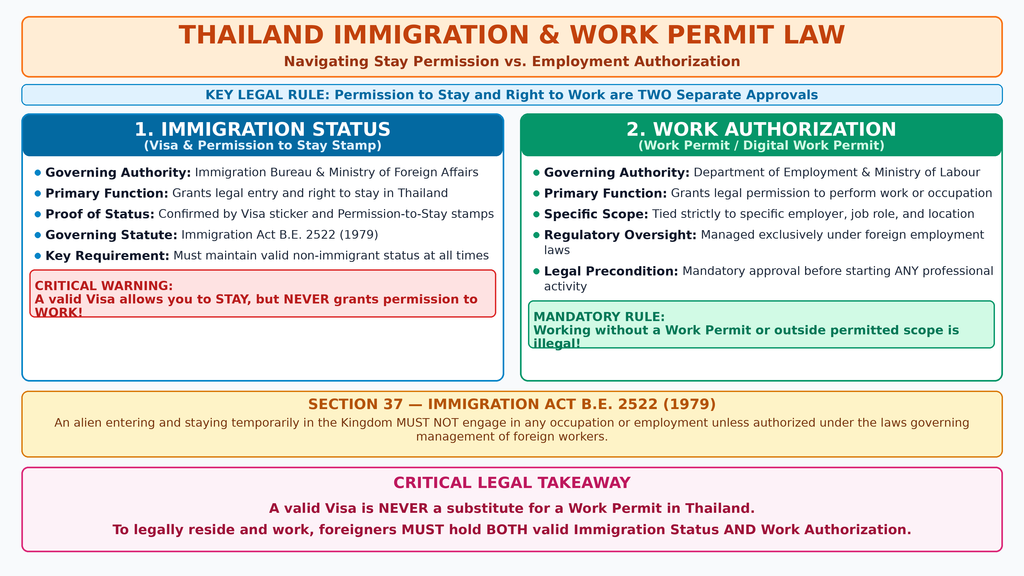
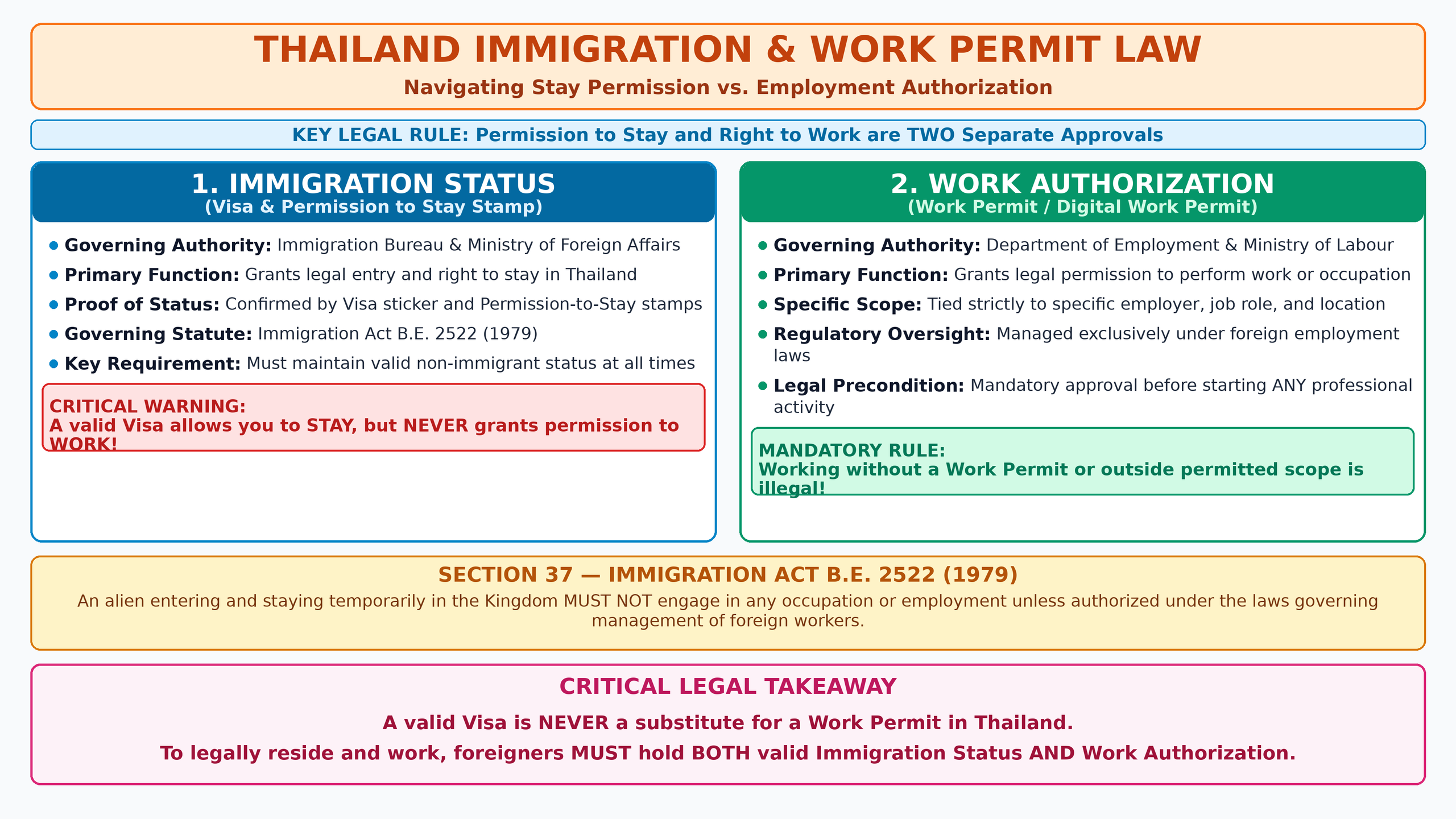
Immigration permission alone does not automatically authorise employment.
Section 37 requires a foreign national staying temporarily in Thailand not to engage in an occupation or employment unless properly authorised under the applicable laws governing foreign business or the management of foreign workers.
Accordingly, a foreign employee should normally consider both:
Immigration status
and
Work permit / legal authorisation to work
before commencing employment.
A valid visa by itself should not be treated as a substitute for a work permit where a work permit is legally required.
90-Day Reporting Under Thailand Immigration Law
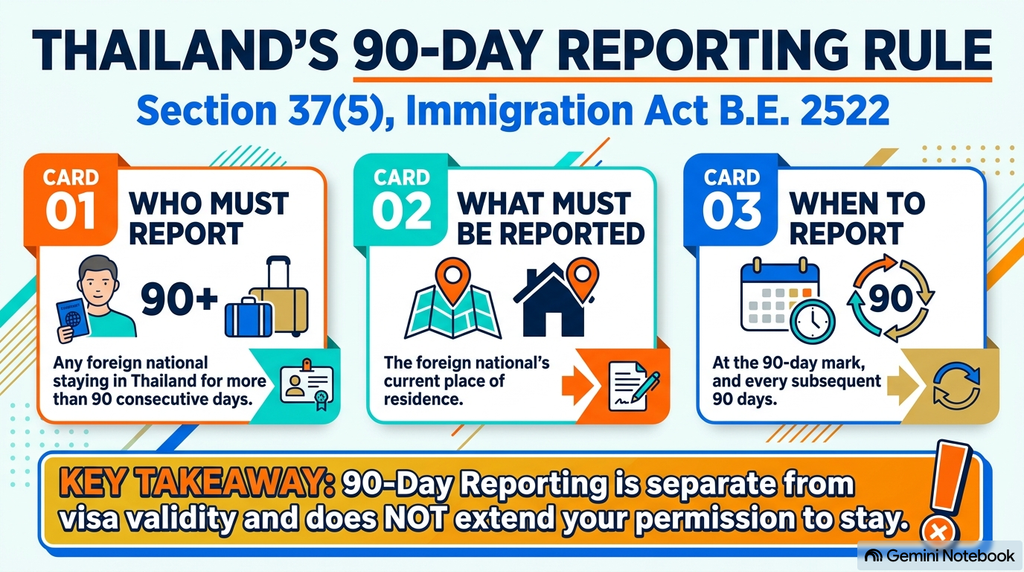
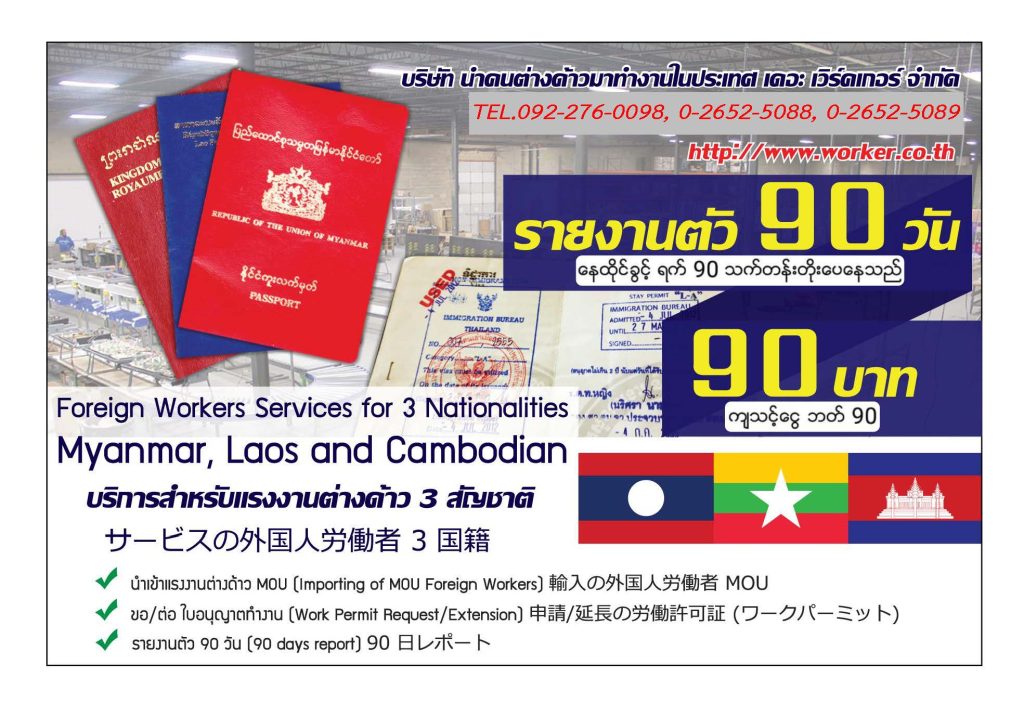
Foreign nationals who remain in Thailand for more than 90 days have an ongoing reporting obligation.
Under Section 37(5), a foreign national staying beyond 90 days must notify the immigration authority of his or her residence when the 90-day period is reached and continue doing so at every subsequent 90-day interval.
This requirement is commonly known as:
90-Day Reporting
It is separate from a visa extension and does not extend the foreigner’s permission to stay.
Foreign nationals should therefore distinguish between:
- visa validity;
- permission to stay;
- extension of stay; and
- 90-day reporting.
They serve different legal functions.
TM30: Accommodation Reporting Under Thailand Immigration Law
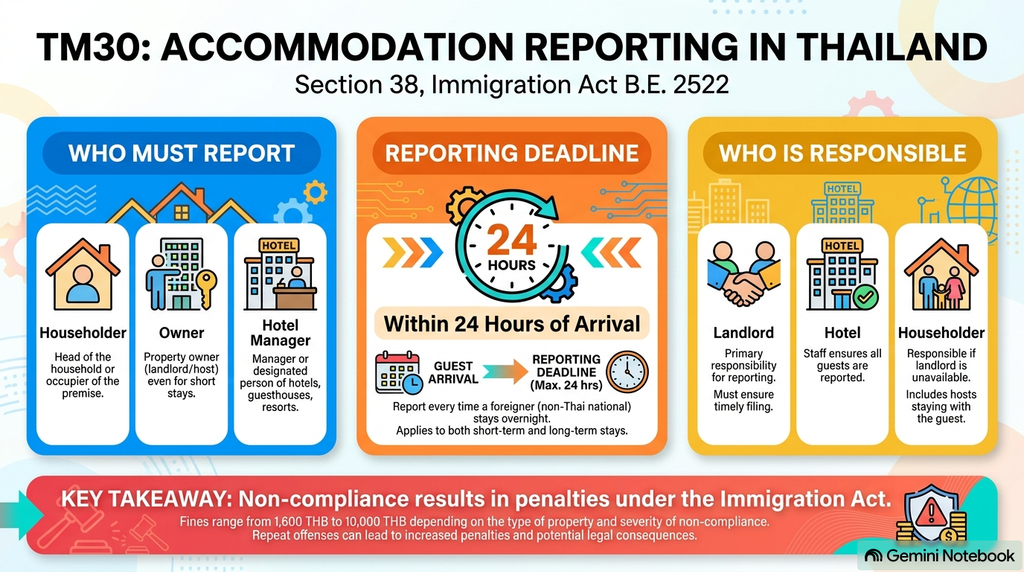
Another important immigration requirement concerns reporting the accommodation of foreign nationals.
Section 38 requires a householder, owner, possessor of a residence or hotel manager who provides accommodation to a foreign national permitted to stay temporarily in Thailand to notify the competent immigration authority within 24 hours of the foreign national taking residence.
This obligation is commonly referred to as:
TM30 reporting
Depending on the accommodation arrangement, responsibility may fall on a landlord, hotel, householder or other person falling within Section 38.
Failure to comply may result in penalties under the Immigration Act.
Re-Entry Permit Under Thailand Immigration Law: Why It Matters
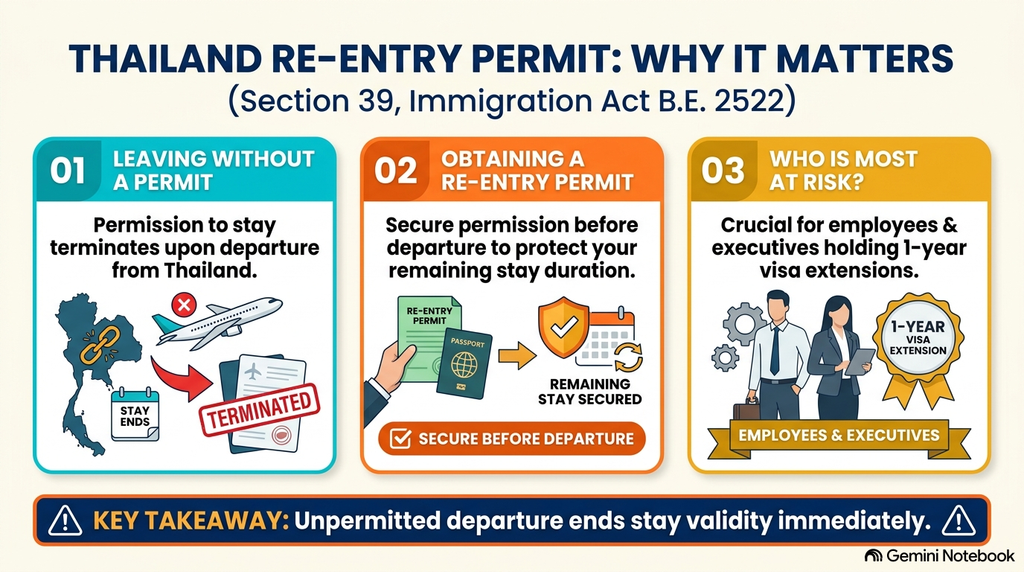
A foreign national holding permission to stay in Thailand should be particularly careful before travelling overseas.
Under Section 39, if a foreign national who has temporary permission to stay leaves Thailand, the existing permission to stay generally terminates.
However, where the foreign national obtains permission to re-enter Thailand before departure and returns while otherwise admissible, the foreigner may continue to stay for the remaining period of the original permission.
This is commonly known as a:
Re-Entry Permits Under Thailand Immigration Law
This rule is particularly important for foreign employees and business executives holding a one-year extension of stay.
Leaving Thailand without the appropriate re-entry permission may cause the existing permission to stay to end.
Common Thailand Immigration Compliance Issues for Foreign Employees
Foreign employees and their employers should carefully monitor several compliance matters:
- whether the visa category matches the actual purpose of stay;
- the expiry date of the current permission to stay;
- work permit validity;
- 90-day reporting;
- TM30 accommodation reporting;
- extension of stay applications;
- re-entry permission before travelling abroad; and
- changes in passport, employer, workplace or other relevant circumstances.
Immigration and work-permit requirements frequently interact, so handling one without checking the other can create avoidable problems.
Thailand Immigration Law and Work Permits Are Different
A frequent misunderstanding is that a visa automatically gives a foreign national the right to work.
That is not necessarily the case.
Immigration law regulates a foreigner’s entry and stay in Thailand, while foreign employment laws regulate whether and under what conditions the foreign national may legally work.
For an employed foreign national, both areas therefore need to be considered together.
Penalties for Non-Compliance with Thailand Immigration Law
The Immigration Act also contains offences and penalties.
For example, the Act provides penalties for certain breaches of the obligations imposed under Section 37 and Section 38.
The consequences can vary depending on the particular breach.
Businesses employing foreign personnel should therefore treat immigration compliance as an ongoing corporate compliance matter rather than as a one-time visa application.
Practical Thailand Immigration Law Compliance Checklist
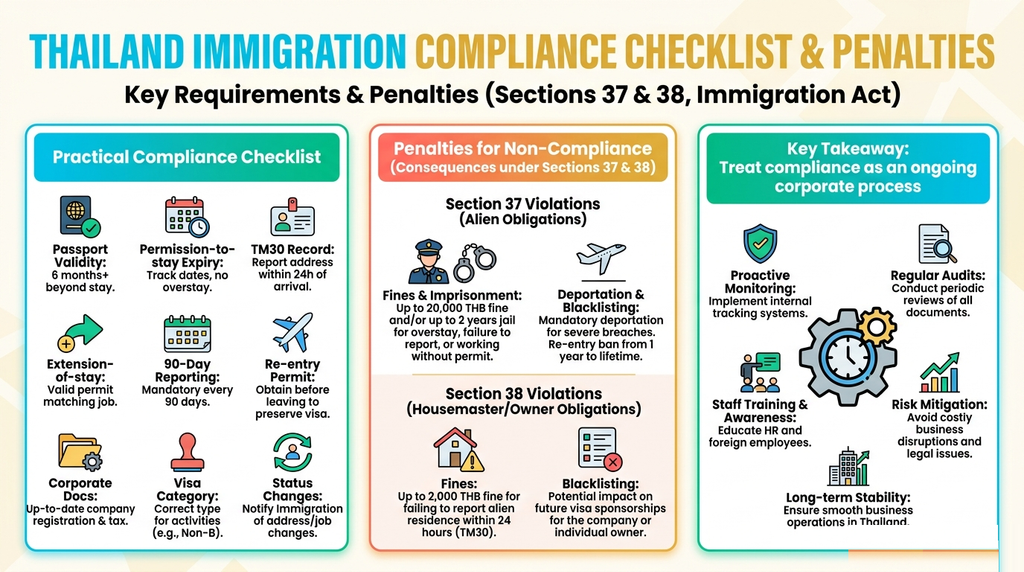
Before employing or continuing to employ a foreign national in Thailand, businesses should consider checking:
- Passport validity
- Appropriate visa category
- Permission-to-stay expiry date
- Work permit or other applicable work authorisation
- TM30 accommodation record
- 90-day reporting status
- Extension-of-stay requirements
- Re-entry permit before overseas travel
- Corporate supporting documents
- Changes to employment, office location or passport information
The exact documents and procedures depend on the facts of each case.
Conclusion
Thailand Immigration Law provides the legal framework for entry, temporary stay, reporting obligations and departure from Thailand.
For foreign employees, the most practical compliance issues frequently include the correct visa category, valid permission to stay, work authorisation, 90-day reporting, TM30 reporting, extensions and re-entry permits.
Companies employing foreign nationals should review immigration and work permit requirements together and should avoid relying solely on the visa label or passport stamp without considering the underlying legal requirements.
Visa & Work Permit Services in Thailand
Mr. Work Permit & Bookkeeping Co., Ltd.
We provide professional assistance for foreign individuals and companies in Thailand, including:
- Non-Immigrant B Visa
- Visa Extension
- Work Permit
- Work Permit Renewal
- Change of Employer
- BOI Visa & Work Permit Coordination
- Company Registration
- Immigration Compliance
- 90-Day Reporting
- TM30 Support
- Re-Entry Permit
- Corporate and Employment Documentation
For businesses employing foreign personnel in Thailand, our team can review the immigration and work permit requirements based on the circumstances of each case.
Source: Immigration Act B.E. 2522 (1979) and Immigration Bureau training materials provided for this article.
Disclaimer: This article provides general information only and does not constitute legal or immigration advice for any specific case. Immigration rules, ministerial regulations, administrative procedures and documentary requirements may change. Applicants should confirm the requirements applicable at the time of filing.